Set del perfumista
At this point we are going to learn a little more about the world of perfume, including how perfumers make their blends to create new scents.
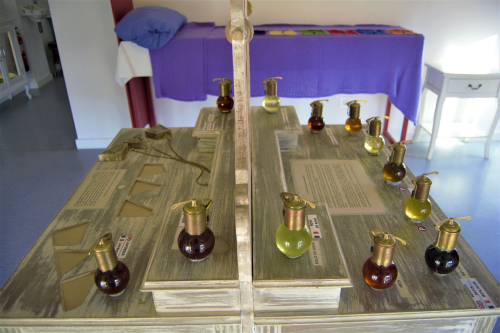
On one side we have a selection of perfumes such as geranium, the famous patchouli or musk. Also fixatives such as benzoin or vetiver. And by mixing some of them we can obtain, for example, a rose perfume without using rose.
How can we learn this? We will see it on the other side of the table. It's very simple: we fit the pieces in each puzzle, read what we have left at the bottom and press the button. The perfume that would be formed by adding these very different aromas will light up.
One last comment: this part of the museum is very fragile, so please treat it with care. Lift the lid of each perfume to sniff but do not pull the bottle.
Oenological visit:
The perfumer's aromas in addition to flowers like violet or rose which we can hear in locution 6, or citrus like bergamot which we can find it in locution 5, or moss which is an aroma of vegetal origin that reminds us of a walk in a forest, backgrounds where the aromas of moss fungus and wet earth etc, quality wines appear and are usually found in red varieties like Pinot noir, Cabernet franc and Nebbiolo. They also include aromas such as musk, which is of primary origin, with hints of white flowers and a certain animal odour. Common in varieties such as Gerwustraminer and Syrah, it is also very common in the most prestigious Burgundy cru, both in whites and reds. Likewise, Bordeaux Merlot, from the more traditional houses, usually has that musky smell which combined gives aromas like the one here present of spring which is not an aroma that we find in wines in this way but is aroma that we can find in white varieties and in fresh white wines, as it is a fresh and very floral aroma, typical of this style of wines.
Posters:
Although the history of perfume is very old and has accompanied all cultures, in ancient times, flowers, aromatic plants and resins were first and foremost raw materials that were dedicated to the worship of the Gods. Until the spread of fumigation, perfumes were used for therapeutic purposes. Eau Admirable or Eau de Regina was the first fragrance created for commercial purposes.
At the end of the 19th century, the perfume trade and industry was organised. The first synthetic products were born and with them modern perfumery, and it was after the Second World War that perfumes and haute couture joined forces, inspired by the seduction of Hollywood.
In the 1950s, men's perfumes were created, and in the 1960s, fresh waters appeared.
In our commercial times, they do not correspond to a single classification, but are combined, giving rise to combinations such as amber hesperides, oriental floral, etc. We invite you to make your own combinations.
Comentarios
Aún no hay comentarios.