Juego de las cafeteras
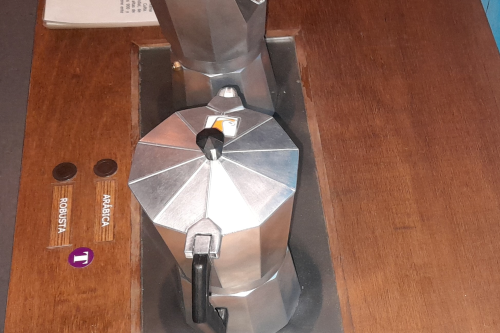
Let's start with a little game to differentiate, with our sense of smell, the two varieties of coffee that exist, Arabica and Robusta.
Arabica, with a very intense and fruity aroma, and Robusta, with a milder aroma.
It is very simple to play: we smell both coffee pots, decide which one is of each type and check if we have got it right by pressing the buttons next to each name. For example, pressing the button next to the Robusta sign will light the burner on the Robusta coffee maker, and the same with the Arabica.
Signs:
BY ITS AROMA WE KNOW IT...Coffee.
One of the legends about the discovery of coffee is about a shepherd named Kaldi. Kaldi noticed the strange behaviour of his goats that were jumping around very excited and full of energy after they had eaten the fruit and leaves of a certain bush.
So he took some fruit and twigs from that bush to the prior of the monastery in Chehodet (Ethiopia) and told the Abbot the story of the goats and how he had felt after eating the leaves. The Abbot decided to cook the branches and the cherries; the result was a very bitter drink which he immediately threw into the fire. When the cherries fell into the embers they began to roast, the green seeds inside produced a delicious aroma that made the Abbot think of making a drink based on roasted coffee.
Types of coffee:
1. Arabica
A full-bodied coffee with a fruity aroma, its beans are thick and elongated, with a sinuous groove. It is grown in Central America and Africa. Its best known varieties are Kenia (Cimaza), Portocabello (Colombia) and Culta. It makes up 65% of the world's production and is of the highest quality. It is grown at high altitudes in all producing countries, between 900 and 2000 m above sea level. It contains between 0.8 and 1.5% caffeine.
Arabica coffee varieties:
Common or typical Arabica: It takes different names depending on the countries where it is grown, such as Nacional in Brazil.
Bourbon Arabica: Born on the island of Bourbon (Mauritius), it became acclimatised in Brazil (Santos) and later in Kenya.
Arabica Moka: Originating from Moka (Yemen), it has been acclimatised in South and Central America, as well as in India and Africa. There are also Ethiopian Mokas including Sidamo and Harrar.
Magarogype Arabica: Originates from Magarogype (Bahia region in Brazil).
2. Canephora or Robusta
Small round coffee beans with a lot of caffeine, with a straight groove, originally from Zaire. It is called Robusta because it is immune to the fungus Hemillea vastratix and from the French Canephore who discovered it.
Its best known variety is Robusta. It is cultivated in the Ivory Coast, Vietnam, Uganda, etc... Robusta coffees account for 35% of the world crop. They are produced below 600 m.
Their caffeine content is between 1.8 and 2.4%.
A little history of coffee
Coffee spread to Arabia via pilgrims travelling to Mecca and soon became a common beverage, and a drink adopted by the Islamist religion. The spread of coffee from its countries of origin was due to Venetian and Dutch traders. The French then planted it in Martinique, and it later spread to Brazil and all Central and South American countries. Pope Clement VIII allowed its consumption as a good drink for the Christian faithful.
It was brought to Spain by royalty. It was in the 18th century with the reign of the Bourbons (Charles III) when coffee began to be consumed in our country. Although it is true that Spain was one of the later European countries in its consumption, it nevertheless came to have one of the best raw materials thanks to the American colonies, which turned out to be an excellent growing area.
Coffee cultivation
For climatic reasons, coffee is only grown in tropical countries and covers a strip of land that surrounds the planet, delimited by the parallels between the Tropic of Cancer at 23º North latitude and the Tropic of Capricorn at the same degrees South latitude, with a width of more than 4,000 km. The development of coffee depends mainly on the soil and climate of the country. It is cultivated in more than 60 countries, including Brazil, Vietnam and Colombia.
Brazil, with 40 million bags, is by far the largest coffee-producing country.
-Vietnam 19 million bags.
-Colombia 9 million bags.
-Indonesia 8 million bags.
-Mexico 8 million bags.
Coffee in Spain 2010
Foreign trade
Spain is the third largest importer of green coffee in Europe, behind Germany and Italy, with volumes having increased by 4.48% during 2010, reaching 267,499 mt. From these we must subtract 28,416 mt, which again left our country in the form of re-export of green coffee and export of roasted coffee and soluble coffee, resulting in a net balance of coffee destined for domestic consumption of 239,083 mt, 9,558 mt more than the previous year. Vietnam continues to be our main supplier with a 35.39% market share, having dropped four points from the previous year. On this occasion, this fall has not been taken advantage of by Uganda, which in turn experienced a 17.31% drop, but by Brazil (4.86%) and Ivory Coast (34.27%).
Coffee in Spain 2010
Domestic Consumption
8 out of 10 Spaniards consume coffee on a daily basis, attracted by its aroma, taste and stimulating effects.
According to a study carried out by the Spanish Coffee Federation and CICAS - Centro de Información Café y Salud. They collected the opinions of 2,500 people with sectorised results for each of the 17 Autonomous Communities. The final result is an accurate x-ray of the habits and attitudes of Spaniards towards coffee consumption.
84% of Spaniards have coffee for breakfast, 66% have a cup for after-dinner conversation and 51% do the same in the middle of the morning.
58% consume coffee both at home and at the bar, compared to 28.4% who only drink it at home and 13.5% who only drink it at the bar.
Decaffeinated coffee
Decaffeinated coffee is obtained from green coffee.
This coffee undergoes a process of caffeine extraction to levels below 0.12%.
The decaffeination process consists of subjecting the green coffee to a kind of water bath, where the hot water makes the beans swell and allows the caffeine to be dragged out easily, using a suitable solvent.
It is then dried and the decaffeinated coffee enters the roasting process in the same way as normal green coffee.
In this process, the coffee loses some body and acidity increases, which can be compensated for by a suitable roasting process.
Roasted coffee
Cafés La Estrella, one of the most important brands of the Nestlé Group, was founded by José Gómez Tejedor in Badajoz in 1887.
Gómez Tejedor had learned the roasting system (with a little sugar) in Mexico and in 1901, he obtained an exclusive invention patent for the roasting of roasted coffee.
From then on, this type of coffee made a name for itself on the market (and in neighbouring Portugal) and was so popular that it even became a supplier to the Royal Household.
What roasted coffee brings to espresso coffee:
-Colour
-Bitterness
-Slightly darker cream
Coffee characteristics
A good coffee is particularly appreciated for its body, acidity and aroma.
The body is the sensation of strength of taste and fullness that fills the mouth when a sip of coffee is held for a few moments.
Acidity is the strong flavour that brings the coffee to life. It is a slight spicy or sour sensation experienced on the tongue.
Aroma, which is more difficult to define, corresponds to the fragrance or smell of the coffee. The character of the fragrance indicates the nature of the taste: sweet smells lead to sour tastes, and pungent smells lead to sharp tastes. The intensity of the fragrance reveals the freshness of the coffee. The aromatic character of a coffee depends on the type of coffee, but the intensity of its aromatic character is related to the time elapsed between roasting and processing.
Olfactory characteristics
(a) Primary: those that constitute its fragrance. They come from the variety of the plant, the soil in which it has been grown, its cultivation and its processing (separation of the skin and pulp from the fruit). Coffee fragrances can be floral, fruity, vegetal and herbaceous.
(b) Secondary: those that give rise to the aroma. They arise during the coffee roasting process, with more than 700 different aromatic components. Coffee aromas can be classified into dried fruits, caramel, chocolate, syrups and cereals.
c) Tertiary: these are the compounds derived from the infusion. They are perceived in the aftertaste, a sensation that remains in the mouth after tasting the infusion, and can be classified as terpenes (turpentine, chicory, oregano...), spices (nutmeg, pepper...) and coals (smoke, tar, tobacco...).
The most expensive coffee in the world
It is Kopi Luwak coffee. Its production begins with the ingestion of coffee seeds by the luwak or civet cat, a large cat-like feline that lives in areas of the Asian jungle, and then they are collected from its faeces, carefully selected, cleaned and roasted. Kopi means coffee and Luwak means civet. Its production is centred in Indonesia, Vietnam, although here a weasel is involved in the process, and mainly the Philippines, with its main consumers being Japan and, increasingly, the United States.
It has a delicious taste with hints of chocolate and caramel, probably due to the fermentation it undergoes during digestion by this animal, which only eats the highest quality grains. The price of a kilo of this exotic coffee can be around 700 euros and a cup in New York can cost $40.
Comentarios
Aún no hay comentarios.