Callejón de los malos olores
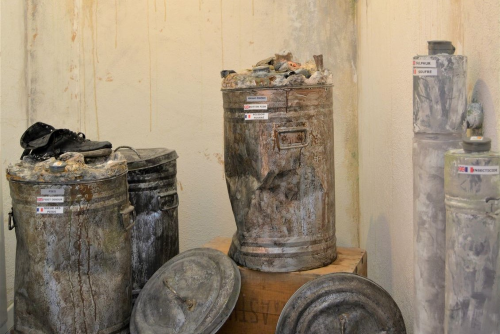
Since the beginnings of medicine, it has been known that bad smells can be used to detect illnesses and even make you sick, which is why the scent museum dedicates this rubbish alley to them.
All the aromas in the museum are voluntary to smell, i.e. everyone decides what they smell and what they don't smell. And this is perhaps the most voluntary corner... Do you dare to smell feet or rotten fish?
Oenological visit:
In this alley of bad smells we are going to talk about wine defects.
From a deficient ripening of the grapes to a bad storage of the wine, passing through all its elaboration processes, the wine can develop defects, but nowadays there is a knowledge of viticulture, oenology and conservation that makes it more and more difficult for defective wines to reach us.
Sulphur appears here as a defect, although its use as a preservative is common in wine, as it is in hundreds of food products, sometimes a recently bottled wine can have this aroma, but normally when it is left to breathe it disappears.
It is very delicate to talk about absolute defects in wine, as many wines can have a higher than average score in some parameter such as acetic acid and it is not necessarily a defective wine as they are more personal and risky wines but with great personality.
Mostly we only find two defects in marketed wines, the TCA or known as cork aroma, which is a smell that reminds us of humidity or wet cardboard, which is usually transmitted by a disease of some natural corks and the oxidised smell of wines that have been open for a long time and have lost their qualities.
Posters:
ODOUR IN HEALTH AND DISEASE.
(Adolfo Toledano)
"He who rules the smell rules the hearts of men". Patrick Süskind
The relationship between smells and disease is as old as medicine. The relationship between unhealthy smells in certain environments and the development of certain diseases in the population exposed to these smells led the classics to think about the odorous aetiology of some diseases. Likewise, the disease "per se" is odorous, being indicative of some specific pathology. With all this, a close relationship was established between the nose and the interior of the organism, between smell and disease. Smell could make you sick, it was evidence of illness and, moreover, it could cure.
BAD SMELLS AS A MANIFESTATION OF DISEASE
For the Greek classics, unhealthy air, evidenced by bad odour, was responsible for disease by altering the humours of the organism. These "altered humours", these "bad humours", were to be eliminated by the organism itself, in an attempt to bring about a cure. According to Hippocrates: "the invasion of evil can be evidenced by the loss of the odour of health and the appearance of a morbid odour". In other words, the disease that was eliminated from the organism smelled and the odour signalled disease. In his Epidemics he comments: "children who have sores in their ears, and whose humour is fetid but purges from their ears, do not suffer from alferecía". That is to say that the bad humour, the fetid humour, the stench, if expelled, did not produce complications, but rather favoured the natural evolution to the cure of the pathological process. Avicenna also observed that the smell of urine changed in relation to many diseases.
Odour is still one of the most important manifestations of certain pathological processes: the fruity odour of diabetic urine; the acetone odour of vomiting or ketonemic urine; the stercoraceous vomiting of intestinal obstruction; the putrid halitosis of necrosis or some infections of the respiratory tract; the halitosis of certain digestive tract conditions such as pyorrhoea or oesophageal diverticula; the cacosmia of ocena or foreign bodies in the nostrils; the rancid odour of pus from common coccal infection; the musty, damp smell of Pseudomonas infection.
ODOUR AS A TREATMENT FOR DISEASE
Odour and disease have always been closely linked. For this reason, perfume was also traditionally used as a major therapeutic element.
Hippocrates frequently recommended odoriferous fumigations: for this purpose, it seems that they used a hermetically sealed vessel covered at the top with a cloth through which a tube was passed to conduct the medicinal vapours into the open mouth of the sick person. One of the most commonly used was myrrh wine, a symbol of the aromatic and impure, according to Greek mythology.
Avicenna used strongly perfumed substances for his treatments, such as rose water, sandalwood, camphor, aloe wood incense, ambergris, frankincense, musk, asafoetida, cavo or almond, which "dried the air to avoid its pestilence and putrefaction.
Sometimes even the "putrefied miasma" itself was used for healing. Thus, in China, as early as the 10th century, the insufflation of smallpox scab powder into the nasal cavity was practised as a preventive practice. This prophylactic insufflation was still practised up to the 20th century, the true forerunner of today's vaccines.
Comentarios
Aún no hay comentarios.