Aromas del Colegio
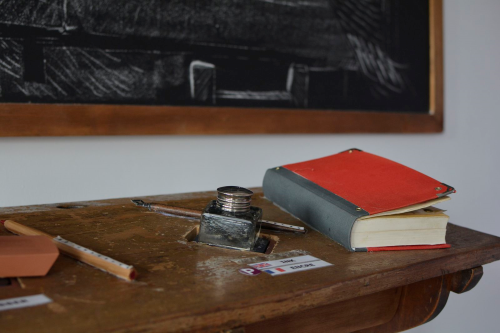
This old wooden desk in front of us could tell us many stories of the children who sat on it, as it was used in the schools of Santa Cruz de la Salceda, many years ago, in this very building in which we are sitting.
In it we find smells that flooded the schools years ago, such as the smell of Chinese ink for writing or the smell of cream gum. And also, two books with aromas, the one on the right tells us about painting and smells of oil and the one on the left, which tells us about cinema... What does it smell like?
Oenological visit:
Among the aromas we remember from school, we have the Chinese ink aroma of tertiary origin, which appears in great red wines and is associated with long ageing. It is a descriptor in quality red wines, such as Cabernet Sauvignon, Tempranillo, and wines with great aromatic intensity.
On the other hand, rubber has an aroma of cream and popcorn of butter, with which these aromas would belong to the dairy that can be heard in locution 4 of the lying table.
Posters:
Smell is the sense that is most intimately related to memory and most fragilely linked to language. It is complex to describe a smell, we do it by relating it to other smells or objects and describing how they make us feel.
But naturally we have to learn to name smells, and to recognise them, since their name is the only tangible reference we have to "point them out".
How to discover a smell? Both its intensity and its nature are totally subjective. Smell is not a property of the molecule but the result of the way we perceive it.
The members of the Smell Club in Japan have created a website "Nioi-bu" which not only describes the different smells of the world but also locates them on a Google map and they have the challenge to create an internet function for smelling.
The smell of work and success in Japan
Scents of sandalwood, lemon, cypress or eucalyptus are part of the new workplace therapy that Japanese tycoons have introduced in their offices or workshops in Japan. Doses of one or the other scent at different times influence the mood of the workers. Now the question arises, what should the smell of work be? Not unpleasant, of course, say everyone who works in Japan.
According to a recent Japanese study, the smell of money makes employees more efficient and therefore motivates them to succeed at work. What may seem ridiculous to many, to others, as in the case of Patrick McCarthy, is inspiring.
PAINTING BOOK AND OIL SCENT
The relationship between painting and scent, leaving aside the symbolism of the content of the paintings, is difficult to pin down.
The collections created by asking each artist to produce a work linked to an olfactory evocation are efforts to establish this relationship between the sensation produced by the scent and the visual sensation of the painting. However, it will be the language or the text that will ultimately detail the author's intentionality, expressed in the image.
Another experience, which may eventually influence the "material" part of the painting, is that of a team of Japanese scientists at Keio University in Minato, Tokyo, who have developed a technology that allows odours to be printed using a modified ink-jet printer which, by means of small pulses of material, converts the print into an olfactory screen capable of switching from one aroma to another from among the four aromas it uses.
We show you this work by Giotto in which reference is made to the scents of myrrh and aloe with which the bandages used to cover the body of Jesus Christ were tarnished. The literary source for the scene depicted in this painting is the Gospel according to John, 19, 38-42
"After all this, Joseph of Arimathea, who was a disciple of Jesus, but secretly for fear of the Jews, begged Pilate to let him take the body of Jesus; and Pilate gave him permission. Then he came and took away the body of Jesus.
Nicodemus also, who had previously visited Jesus by night, came bringing a mixture of myrrh and aloes, about a hundred pounds.
So they took the body of Jesus, and wrapped it in linen cloths with spices, according to the custom of the Jews for burial.
And in the place where he was crucified there was a garden, and in the garden a new tomb, in which no man had yet been laid.
There, therefore, because of the preparation of the passover of the Jews, and because that sepulchre was near, they laid Jesus.".
FILM BOOK AND POPCORN AROMA
Associating a smell with visual information opens up the possibility of storing its memory in a more lasting way.
In the first attempts to make films with scent, two major drawbacks were noted. The perfume that accumulated in the cinemas could not overcome the olfactory saturation it provoked in the audience, and on the other hand, the addition of aromas to existing films was considered an offence both to the aesthetics of cinema and to the director's creation.
In the 1960s, the first attempt was made to surprise the audience with aromas and to make them part of the film's plot. The technology applied to film was heralded as much more accurate and realistic than all previous attempts at scent-based filmmaking. In "Perfume of Mystery" by director Jack Cardiff, osmologist Laube and producer Todd Jr. the story is told of a puzzling crime in which the heiress was identified by her perfume and the murderer by the scent given off by his pipe, both of which are key to the development of the plot, which incidentally took place in Spain, in Malaga, and which was christened "Holidays in Spain".
Filmmaker John Waters, in 1981, made a parody of the idea in 'Polyester', with 'Odorama' scratch-and-sniff cards, and Waters' joke was copied by the makers of the 2003 animated film, 'Wild Vacation' who claimed it was made in his homage.
In 2000, Hong Kong director Ip Kam-Hung released Lavender, a fantasy romance in which an aromatherapy shop owner falls in love with a wounded angel who has fallen on his balcony. To enhance the air of the film, the producers spent a million dollars on devices that dispersed flower scents into the air conditioning systems of the theatres.
In 2006, two theatres at Shochiku Cinemas screened the American adventure film "The New World" while running a computer system whose software emitted seven different aromas from the back of the last seats in the cinema, adding to the high-tech sound effects.
Today, audio-visual entertainment companies want to increase the quality of our experiences when we play games on consoles or computers, or when we watch movies. Scent Sciences wants to bring this type of system that goes beyond video and sound into the home. ScentScape is a device capable of recreating smells based on the content of the videos or games we are playing. The scents are created by means of refillable cartridges.
In line with the above, we would agree that the attempt made with the film "Perfume of Mystery" foreshadowed the arrival of our times, in which the manipulation of aromas has become a powerful tool for influencing consumer behaviour.
Comentarios
Aún no hay comentarios.