Curiosidades y anécdotas
You can observe in this corner:
Aromatic stamps
Although it may seem hard to believe, the first flavoured stamp in the world was manufactured in Spain, in the Heraclio Fournier house in Álava, the company known worldwide for manufacturing the Spanish playing cards.
The most curious thing of all is that the stamp was not made for use in Spain, but at the request of a small Asian country, Bhutan, which, according to the UN, has one of the highest levels of happiness in the world. In 1973 it decided to put into circulation the world's first scented stamp, perfumed with a heady scent of rose essence.
Since then, many other countries have imitated Bhutan's initiative. One of the most exotic was the model launched in China in 2007, the year of the Pig in China, which smelled of sweet and sour pork. In Spain, they have never been issued.
The latest novelty is from Belgium, March 2013: the world's first stamps that, in addition to offering a scent, can also be tasted. The chocolate flavour comes from the printing varnish, which contains chocolate elements at an incredible 40%. The dark chocolate flavour comes from the cocoa oil that releases the gummed adhesive layer when the stamp is moistened. The stamps are printed on Tropimatic Chocolate paper from UPM Raflatac. It is a tribute to chocolate and distinguished Belgian chocolatiers in various forms.
Curiosities on paper and anecdotes
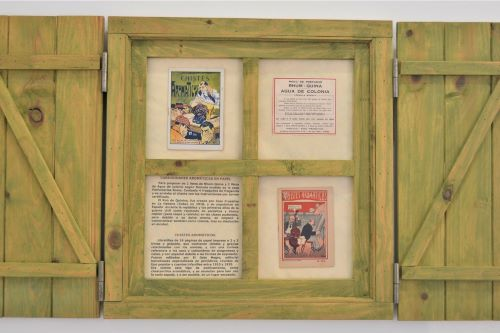
In this window you have objects from around 80 years ago in front of you.
Eau de Cologne preparation kit label:
To prepare 2 litres of Rhum-Quina and 2 litres of Eau de Cologne according to model formula, from the house of Perfumerías Roma. It contained 4 bottles of fragrance, and was sent to the customer with instructions by registered mail.
Ron de Quinina was created by Joan Crusellas in Havana (Cuba) in 1918, and became popular in Spain during the republic and the first years of the civil war as a parasite repellent and hair tonic (for dandruff and baldness) in the wealthy classes, but due to its sweet aroma, it also began to be marketed as a cologne, after dissolving it in alcohol.
Aromatic Jokes
Booklets of 16 pages of paper printed in 2 and 3 inks and stapled, containing jokes and graces related to aromas, and with a curious reference to the customs and habits of Aragonese and priests, and with special detail to the forms of expression. They were published by El Gato Negro, a Barcelona publishing house specialising in newspapers, popular magazines and children's stories between 1910 and 1935.
Publications of this type were common, like aromatic jokes, and they are advertised to be read with a blocked nose, and if possible, in a coughed-up place.
Posters:
AROMATIC STAMPS
In the Scent Museum we show you:
1973 - Bhutan - Rose - The world's first scented stamp.
1998 - Singapore - Flowers - Homage to various flowers. Canna lily, false flamboyant, Singapore daisy, Aire sinphor, pink zephyr lily, gold candlesticks, patuju and butter flower.
1999 - Brazil - Burnt wood - the seal of the forest in prevention of forest fires, gained worldwide recognition.
2001 - Switzerland - Chocolate - Commemoration of the Centenary of the Swiss chocolate industry federation.
2001 - Hong Kong - Tea - Homage to tea culture.
2001 - Brazil - Coffee - Tribute to one of the country's main industries.
2003 - Russia - Fruits - various flavours of melon, apple, pear, pineapple or strawberry.
2005 - Iceland - Apple and Pine - Homage to Christmas 2005.
2006 - Australia - Rose - Homage to the flower
2006 - India - Sandalwood - Homage to this fragrance used by Hindus and Buddhists.
2007 - India - Rose - A tribute to the flower.
2008 - India - Jasmine - Homage to the flower
2008 - Qatar - Traditional perfumes - Al Marash, Oud, Agar and Al Mogbass.
2008 - Argentina - Flowers - Commemoration of the National Flower Festival.
2008 - Andorra - Narcissus - Homage to the flower.
2009 - Thailand - Roses - Homage to Valentine's Day.
2009 - France - Cocoa - Commemorating the arrival of cocoa beans in France.
2014 - Spain - Mandarin and almond. Stamps with aroma and flavour on the reverse, as a tribute to Spanish cuisine.
FRANCISCO DE QUEVEDO
(Sonnet on the stairs leading to the first floor)
Once upon a time there was a man with a nose stuck up,
Once upon a time there was a superlative nose,
once upon a time there was a scribe and a scribe's nose,
once upon a time there was a very bearded swordfish.
He was a sundial with a bad face,
was a pensive tarn,
was an elephant upside down,
was Ovid Nason the most narcissised.
Once upon a time the spur of a galley,
let there be a pyramid of Egypt,
the twelve tribes of noses was.
Once upon a time an infinite nose,
a very great nose, a nose so fierce
That in the face of Annas it was a crime.
Poema al pedo (poster on the wall at the foot of the stairs)
Someone asked me... What is a fart?
and I answered very seriously:
A fart is a fart,
with a body of air and a heart of wind.
A fart is like a soul in pain
that sometimes blows, sometimes thunders,
it's like water that slides
with a lot of force, with a lot of haste.
The fart is like the cloud that flies by
and wherever it passes it sprays,
the fart is life, the fart is death
and it has something that amuses us.
The fart moans, the fart cries
the fart is air, the fart is noise
and sometimes it comes out of carelessness
and sometimes it comes out with a glow.
The fart is strong, it is imposing,
for it is thrown by all people.
In this world a fart is life
because even the priest farts well.
There are educated and ignorant farts
there are adults, there are also infants,
there are fat farts, there are skinny farts,
depending on the diameter of the farts.
If one day a fart knocks at your door
don't close it, leave it open
let it blow, let it spin
to see if there's someone to breathe it in.
Even farts are polite
because the graduates fart,
there's something monstrous about a fart
For if you hold it in, it takes you to the well.
This poem has come to an end
With so much farting that I've done
Comentarios
Aún no hay comentarios.