Ruta de las especias
The Eastern Spice Route has been one of the most exciting adventures of Western culture. They have been the source of wars, the rise and fall of cities, the enrichment of cultures and the source of knowledge for some communities.
They are used to preserve and season food, to make perfumes and even as currency. This is where the expression "paying in spices" comes from...
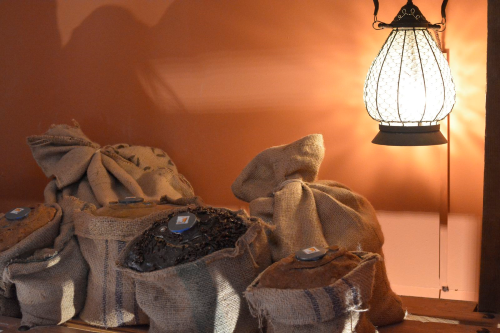
Enjoy this stall of bulk spices and their aromas, so sought after long ago and so common in our daily lives. Pepper, vanilla, star anise?
Wine tour:
On the spice route we find pungent aromas such as pepper of primary or tertiary origin, which appears in great reds. It is often found in Cabernet Franc, Merlot, Cabernet Sauvignon and Pinot Noir. We recognise it in Spain in large vintages of Rioja, in Italy in Piedmont wines, in wines from Rhône, Bordeaux and Burgundy, as well as in wines from the USA and Australia.
And sweeter aromas such as clove, nutmeg, cinnamon, ginger, star anise and vanilla can be both primary and tertiary, with a soft and sweet entry that sometimes becomes sharp, which is associated with ageing in wood, in the mouth they can first be sweet and soft and then become hot and somewhat fiery.
We can find them as a primary aroma in some grape varieties (Syrah, Grenache, Muscat, Riesling and Chenin blanc), it is a distinctive note in wines made with the Syrah variety, especially in great Australian, Californian, South African and French wines, in some Châteauneuf-du-pape it appears as well as in some Priorat wines that combine this variety with Grenache, Merlot and Cabernet. Grenache can also develop this aroma in Mediterranean reds. In white wines of Riesling, Chenin blanc and Gewurztraminer this aroma is usually found, in fact the word "gewurztraminer" means spicy, which in this variety is usually fused with rose aromas.
As tertiary aromas it appears in aged wines, ports and brandies, in aged whites that are very mature and come from the Chardonnay variety, it is best in warm and sunny vintages, in some Bordeaux made from Merlot, in some Riberas del Duero, in Alsatian Tokays of Pinot gris in Sauternes and some Hungarian Tokaji.
Posters:
The Spice Route trade was the most exciting trade for Western civilisation. Wars were fought over spices, families prospered, the centres of political and economic power shifted, and the tables and cuisine of the West were enriched.
Spice, from the Latin species, also known as condiment, is the name given to certain flavourings of vegetable origin that are used to preserve or season food, but have also been used to make medicines, perfumes, in primitive witchcraft rituals... being one of the most valuable products of the economy.
Comentarios
Aún no hay comentarios.