PANTRY
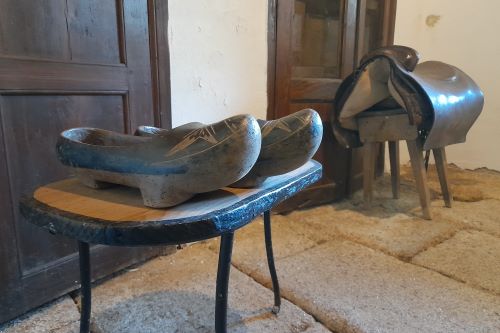
This room was the pantry of the house. Here we can see large cupboards, a chest for storing grain and different objects that were in common use in former times. Above the table, a coffee mill, an almond grater, a scale and a decanter. On the floor, on the left-hand side as you enter, there are two objects that were not originally kept here.
On the one hand, there are some souks. They were brought from his homeland by Otero Pedrayo's wife, Fita Bustamante Muñoz, a woman from Santander whom he married in 1923. Although it may seem otherwise, they are not heavy at all. They were used to go out into the countryside without getting their feet wet and without filling them with mud.
and without getting mud all over them.
Next to the zocos is a saddle. It may have belonged to Ramón Otero Pedrayo's father. He remembers that, until well into the 20th century in Trasalba there were no roads and much less cars and that, surely, visitors to the house were grateful for the presence of donkeys, donkeys and horses to climb the slope that separates us from Santa Cruz de Arrabaldo.
As a member of the Cortes de Madrid, Otero Pedrayo insisted a lot on the improvement of the road network in Galicia, he understood that the roads were fundamental for the improvement of his people and the development of the country. If you look at the road that crosses in front of the door of this house, you will see that it splits a beautiful grove in two. The grove is still owned by the Foundation today. Our writer gave the land free of charge and allowed the chestnut plantation to be divided in two, in order to improve the life of his neighbours. The traditional path, attached to the wall of the house, underneath the grove. When you finish your visit, it is worth following it and going to the church of San Pedro de Trasalba.
Comentarios
Aún no hay comentarios.