OFFICE
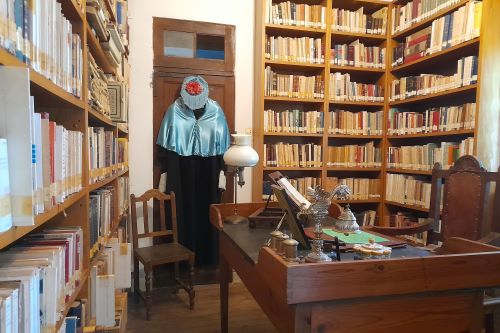
As we cross the dining room we pass a small office on the right, located at the main entrance to the house. It is a silent and cosy room, full of books, which clearly inspires the description of the workplace of Adrián Solovio, the protagonist of Arredor de sí, a novel that has gone down in the history of Galician literature as a generational portrait of the writer himself. In the pages of this work, we read: "In the small, cool office, with a barred window, there are the works of Father Feixóo and also many rows of new books. Some say Alcán, others Mercure. There are some with firm German bindings. Many have notes or margins". All this is, even today, true.
Hanging in this office you can see the toga that the writer wore to enter the University of Santiago de Compostela in 1950. Otero Pedrayo, who had passed the secondary school exams in 1921, taught at the Ourense secondary school, today Otero Pedrayo, in Posío, until the summer of 1937. In August of that year he was repressed and was denied the possibility of teaching again. The writer, who was a teacher by vocation, received the news with great sadness. Those post-war years were very difficult. The murder of friends and political colleagues such as Alexandre Bóveda and Roberto Blanco Torres, the exile of many others such as Castelao and Alonso Ríos, really hurt him.
Retired in this house, he devoted his days to reading and study. Eleven years later, in 1948, Franco's government decided to give him back his professorship. For two academic years, he again taught at the secondary school, but in 1950, at the age of 62, he managed to pass a competitive examination and become a university professor.
He spent eight years in Santiago de Compostela until his retirement in 1958, which he said were the happiest years of his life. The commitment of the university students (such as Xosé Luís Franco Grande, Ramón Lorenzo, Méndez Ferrín...) and their involvement in the cultural recovery of Galicia, encouraged him extraordinarily. Living with Domingo García-Sabell, Ramón Piñeiro and Francisco Fernández del Riego made him extremely happy. These are years of illusion and hard work, trusting in the future of language and culture.
The toga is a symbol. Admission to the university represents an academic triumph and, for the Galician writers of that time, the possibility that Otero Pedrayo, a symbol of pre-war Galicia, would occupy the prominent place that was his due.
Comentarios
Aún no hay comentarios.