05. Primera vista del bosque de columnas
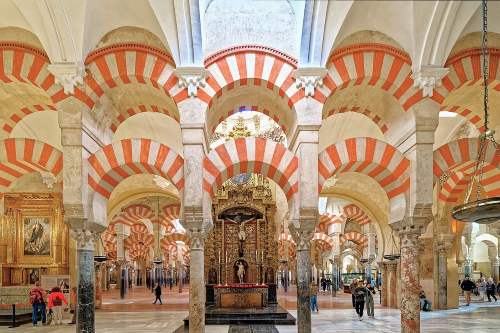
Al cruzar el acceso y dar tus primeros pasos en el interior de la Mezquita-Catedral de Córdoba, la percepción del espacio cambia de manera inmediata, casi sin darte cuenta. Dejas atrás el exterior abierto del patio, la luz directa, la referencia clara del cielo, y entras en un ámbito completamente distinto, donde la arquitectura te envuelve desde el primer momento. Frente a ti no aparece un único punto hacia el que dirigir la mirada, como ocurre en muchos edificios religiosos, sino un espacio que se despliega en todas direcciones, una estructura que parece extenderse sin un límite claro, definida por la repetición constante de columnas y arcos.
Esta primera impresión es fundamental, porque condiciona toda la experiencia del visitante desde el inicio. Aquí no hay un eje evidente, no hay una dirección única, no hay un elemento central que organice el recorrido de forma inmediata. En su lugar, lo que percibes es una multiplicidad, una continuidad, una sensación de espacio abierto dentro de un entorno cubierto, algo que rompe con las expectativas habituales y que genera una experiencia muy particular.
Lo que tienes ante ti se conoce tradicionalmente como el bosque de columnas, una expresión que describe muy bien la sensación que produce. Igual que en un entorno natural, donde los árboles se repiten sin una jerarquía clara, aquí las columnas se distribuyen en una trama regular que se extiende longitudinalmente, creando una percepción de profundidad y de continuidad que resulta difícil de abarcar en un solo vistazo. No hay una nave principal que destaque de forma evidente sobre las demás, sino una estructura homogénea que invita a moverse libremente, sin un recorrido impuesto.
Esta forma de organizar el espacio responde directamente a la función original del edificio como mezquita. A diferencia de la arquitectura cristiana, donde el altar actúa como punto focal y organiza todo el conjunto, aquí el espacio de oración se concibe como un ámbito amplio, abierto y compartido, pensado para acoger a un gran número de fieles en igualdad de condiciones. La orientación hacia La Meca es fundamental, pero la distribución interna no busca jerarquizar, sino facilitar el uso colectivo.
La repetición de columnas y arcos no cumple únicamente una función estructural, aunque es esencial para sostener la cubierta, sino que tiene también una dimensión perceptiva muy potente. A medida que te mueves, la mirada se adapta a ese ritmo constante, a esa repetición, generando una sensación casi hipnótica. Las líneas horizontales y verticales se cruzan, se superponen, creando una retícula que parece prolongarse más allá de lo que alcanza la vista.
Este efecto se refuerza por la relativa baja altura del conjunto. A diferencia de otros edificios religiosos donde la verticalidad domina la experiencia, aquí la altura es más contenida, lo que hace que la mirada se dirija principalmente en horizontal. Esta característica acentúa la sensación de extensión, de continuidad, de espacio que se despliega en lugar de elevarse.
La iluminación juega un papel decisivo en esta percepción. La luz que entra en el interior es suave, filtrada, distribuida de manera uniforme. No hay grandes focos de luz directa ni contrastes muy marcados, lo que genera un ambiente homogéneo, casi envolvente. Esta luz difusa suaviza las formas, elimina jerarquías visuales y refuerza la idea de un espacio continuo, sin interrupciones claras.
A diferencia de otros edificios donde la luz se utiliza para destacar elementos concretos, aquí acompaña el recorrido de forma más sutil. No dirige la mirada, sino que permite que el visitante explore el espacio con libertad, sin imposiciones, sin un camino marcado.
Es interesante detenerse un momento y observar cómo cambia la percepción en función del movimiento. Cuando permaneces quieto, la repetición puede parecer estática, incluso uniforme. Pero en cuanto comienzas a desplazarte, aunque sea lentamente, el espacio cobra vida. Las columnas se superponen visualmente, los arcos se alinean y se desalinean, aparecen nuevas perspectivas, nuevas relaciones entre los elementos.
Este efecto dinámico es una de las claves de la experiencia. El espacio no es algo fijo, sino algo que se transforma con el movimiento del visitante. Cada paso genera una nueva visión, una nueva composición, una nueva forma de entender el conjunto.
Otro aspecto importante es la escala. A pesar de la magnitud del edificio, la relación con el visitante es cercana. Las columnas no son excesivamente altas, la distancia entre ellas es relativamente reducida, lo que crea una sensación de proximidad. No es un espacio que abrume por su tamaño, sino que envuelve, que acompaña, que se experimenta de forma directa.
Esta escala humana refuerza la idea de comunidad. El espacio está pensado para ser compartido, para ser vivido desde dentro, no para ser contemplado desde la distancia. Esta diferencia es clave para entender la lógica de la arquitectura islámica.
En un primer momento, la regularidad de la estructura puede dar la impresión de uniformidad, de repetición sin variaciones. Sin embargo, a medida que la mirada se acostumbra, empiezan a aparecer diferencias. No todas las columnas son iguales, no todos los capiteles tienen la misma forma, no todos los arcos se comportan exactamente igual.
Estas variaciones son el resultado de la historia constructiva del edificio, de sus distintas fases, de la reutilización de materiales, de las ampliaciones sucesivas. Aunque al principio puedan pasar desapercibidas, poco a poco se hacen más evidentes, enriqueciendo la experiencia y aportando una mayor complejidad al conjunto.
Este primer contacto con el interior es, por tanto, mucho más que una simple entrada. Es una introducción a una forma distinta de entender el espacio arquitectónico, una forma que no se basa en la dirección, sino en la repetición, en la continuidad, en la multiplicidad.
Si diriges la mirada hacia los lados, comprobarás que el espacio parece prolongarse sin interrupción, reforzando esa sensación de infinitud. No hay un límite claro, no hay un final evidente, lo que contribuye a crear una experiencia muy distinta de la que se encuentra en otros edificios religiosos.
Esta percepción es una de las razones por las que este lugar resulta tan singular. No responde a las expectativas habituales, no se organiza de forma convencional, y precisamente por eso genera una impresión tan intensa.
A medida que continúes desplazándote entre las columnas, podrás empezar a fijarte en los elementos que componen esta estructura repetitiva, en concreto en las propias columnas que sostienen los arcos. Aunque en este primer momento puedan parecer homogéneas, esconden una gran variedad en su origen y en su forma, algo que será clave para entender cómo se construyó este espacio.
Sigue caminando con calma, dejando que la mirada se adapte al ritmo del lugar, observando cómo cambia la percepción con cada paso, y detente en la siguiente zona para descubrir con más detalle estos elementos que, aunque se repiten, no son exactamente iguales.
Comentarios
Aún no hay comentarios.