17. Historical transition: Christian conquest (1236)
From this point on, the change is not yet clearly visible in what you see. There is no obvious break in the structure, no immediate contrast in the architecture, but a deeper transformation begins to be perceived—one that is linked not so much to form as to the meaning of the building. It is a silent, gradual shift that may go unnoticed at first, but will ultimately shape the way this entire space is understood.
At this point, one of the most decisive phases in its history begins to emerge: the period following the Christian Conquest of Córdoba in 1236. This event would permanently define the use, interpretation, and evolution of the building. What you see here does not yet change radically, but what it means begins to shift—and that difference is key to understanding the whole.
Until that moment, this space functioned as a fully active mosque, organized around Islamic prayer and structured according to its religious, architectural, and symbolic principles. Everything you have seen—the orientation, the repetition of the aisles, the arrangement of the arches, the continuity of the space—responded to a very specific logic, designed for a particular religious practice. However, after the arrival of Christian troops in the city, the building was not destroyed, nor replaced with an entirely new one. Instead, it was consecrated as a cathedral, initiating a gradual process of transformation that would unfold over the centuries.
This fact is fundamental to understanding the uniqueness of the Mosque-Cathedral of Córdoba, because what occurs here is not replacement, but superposition. The Islamic architecture remains, largely preserved, but its function changes. The space is physically the same—the columns, arches, and aisles continue to define it—but its use, interpretation, and symbolism are profoundly transformed.
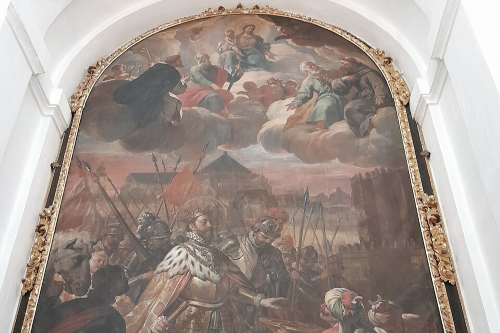
This change begins in a discreet, almost imperceptible way at first, and one of the clearest examples is right in front of you: the altarpiece you can see in one of the side chapels, such as the Chapel of Saint Teresa. Take a moment to observe it carefully—its vertical structure, how it rises against the wall, the presence of images, the way it organizes the scene. It is an element completely different from everything you have seen so far. It does not follow geometry or repetition, but rather representation, narrative, and imagery.
This type of altarpiece introduces a new way of understanding the space—one in which art not only organizes, but also communicates, tells, and reveals. In contrast to the abstraction of the Islamic space, where repetition and geometry created a more open and continuous experience, here there is a clear intention to concentrate attention, to direct the gaze toward specific scenes, figures, and stories.
At the same time, it is important to notice how this element does not eliminate what came before, nor does it break the structure of the building, but instead inserts itself within it. It stands among the columns, adapts to the existing space, and coexists with it. This detail is essential, because it perfectly reflects how this transformation begins—not through major interventions, but through the introduction of new elements within the existing architecture.
From this moment on, the building begins to gradually adapt to the needs of Christian worship. In this initial phase, these adaptations are relatively subtle—chapels, altars, and altarpieces that are incorporated little by little. The mosque remains recognizable, its structure intact, but it begins to accommodate new functions and new ways of use.
Over time, these interventions will become more visible, more ambitious, more transformative. But here you are still at that initial moment, when change is still restrained—more symbolic than structural. It is a particularly interesting point, because it allows you to understand how this transition begins, how a new logic is introduced without yet radically altering the space.
This process is neither immediate nor uniform. It unfolds over several centuries, reflecting different stages, different decisions, and different ways of relating to the past. There is no single intervention that transforms the building, but rather an accumulation of changes, of layers, that gradually overlap.
On a spatial level, this creates a very particular sensation. On the one hand, you still perceive the continuity of the Islamic space—the repetition, the extension, the horizontality. But at the same time, you begin to notice elements that respond to a different logic, introducing another way of seeing and understanding the space.
This point in the route is therefore more a moment of historical transition than an architectural one. What you see does not yet change radically, but what it means does. It marks the passage from an Islamic building to a Christian one, from a mosque to a cathedral, from one form of use to a completely different one.
As you move through this area, it is worth paying attention to these details—these elements that may seem secondary, but are in fact essential to understanding the transformation of the building. They are small interventions that anticipate much larger changes.
The presence of these altarpieces, these chapels, these images shows how the building adapts without disappearing, how it incorporates new layers without completely erasing the previous ones. This capacity for transformation, integration, and coexistence is one of the keys to the value of this place.
From here on, this change will become increasingly evident—not only in meaning, but also in form. The route will lead you toward a much more visible intervention, where the architecture not only adapts, but introduces a completely different language, creating a clear contrast with everything you have seen so far.
Continue forward, paying attention to how these small elements anticipate a larger transformation, because at the next point you will clearly perceive this encounter between two architectural forms coexisting within a single space.
Comentarios
Aún no hay comentarios.