14. Byzantine mosaics
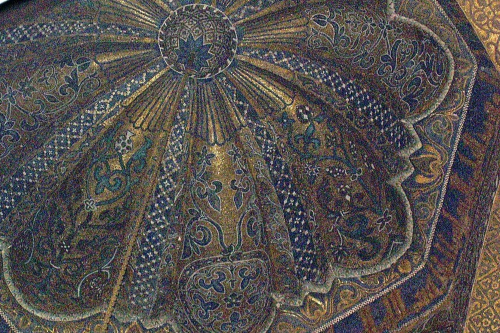
As you approach this area and focus your gaze on the details surrounding the mihrab, you begin to notice one of the most extraordinary elements of the entire complex: the Byzantine mosaics, a decoration that stands out not only for its beauty but also for what it represents in historical, artistic, and cultural terms. Here, the architecture gives way to a surface that shimmers, reflecting light and completely transforming the perception of space, creating a unique atmosphere unlike anything you have seen before.
These mosaics were created during the reign of Al-Hakam II in the 10th century, at a time of great splendor for the Caliphate of Córdoba, and their presence here is no coincidence. Artisans from the Byzantine Empire were brought in to create them, highlighting the importance of political and cultural relations between the two territories. This detail is key, as it explains the exceptionally high technical and artistic level of this decoration, which ranks among the most outstanding examples of Islamic art.
If you look closely, you will see that these mosaics are made up of small pieces, called tesserae, which are assembled with extraordinary precision to create complex compositions. The materials used, especially glass and gold, create that characteristic shimmering effect, and the light, as it strikes these surfaces, does not behave uniformly but rather fragments and reflects, creating a dynamic effect that changes depending on the viewpoint, movement, and the position from which you observe it.
The use of gold is not merely an aesthetic choice; it also holds symbolic significance. In the Islamic context, light and brilliance are associated with the divine, the spiritual, and a dimension that transcends the material world; therefore, these mosaics do not merely decorate but help to create an experience, reinforce the sacred nature of the space, and evoke a sensation that goes beyond the purely visual.
As for the motifs, plant, geometric, and epigraphic forms predominate. You will not find human or animal figures here, as Islamic tradition avoids figurative representation in religious spaces; instead, the decoration is based on repetition, symmetry, and the complexity of the patterns, generating a visual language that conveys order, harmony, and perfection.
The inscriptions appearing on the mosaics are also of great importance; these are texts in Arabic, generally verses from the Quran, which reinforce the religious character of the space and are not merely a decorative element but part of the place’s meaning, integrating into the architecture as yet another expression of the sacred.
If you compare this decoration with what you have seen in other parts of the building, you will clearly notice the difference; here, the ornamental richness reaches one of its highest points, concentrated in a very specific area. It is not a decoration spread throughout the entire space, but rather a localized intensification that reinforces the importance of this point within the complex.
This contrast is fundamental to understanding the logic of the building. While in other areas, repetition and continuity create a more uniform experience, here the architecture becomes concentrated, enriched, and intensified. Everything is designed to highlight this place, to underscore its value, to make it a focal point along the tour.
The quality of these mosaics also reflects the level of sophistication achieved by the Caliphate during this period; it is not merely a matter of technique, but also of intention—of the desire to create a space that combines function, symbolism, and beauty. It is a clear example of how art can become a means of expressing power, culture, and spirituality.
When observing them, it is interesting not only to look at the whole, but also at the details—to look closely, follow the lines, observe how the shapes are organized, how the patterns repeat, and how the colors combine. This careful observation allows one to better appreciate the complexity, precision, and care with which they were crafted.
The relationship between these mosaics and the mihrab is also fundamental. Both elements reinforce each other, creating a very powerful visual and symbolic unity. The architecture frames, the decoration intensifies, and the result is a space that exceptionally concentrates the building’s meaning.
This is, without a doubt, one of the highlights of the tour, a place where history, art, and spirituality come together in a unique way. The presence of these mosaics not only beautifies the space but transforms it, elevates it, and turns it into something more than a mere architectural element.
Before continuing, take a moment—without rushing—to contemplate them calmly, to let the light, the brilliance, and the detail work their magic, to perceive how this space differs from the rest, how here the architecture reaches one of its most intense moments.
When you’re ready, keep moving forward, because the tour will now take you to another area where the space will change once again, offering a different experience within this same building.
Comentarios
Aún no hay comentarios.