03. Fountain of Ablutions
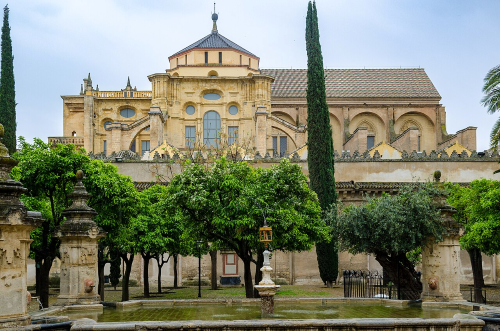
You are now standing in the center of the Patio de los Naranjos, at a particularly significant spot within the complex, where the ablution fountain is located—a key element for understanding how the mosque originally functioned and the role of water in Islamic culture.
Although today it may be perceived as an element integrated into the courtyard’s landscape, almost as a natural part of the tour, it originally served an absolutely essential function—not decorative, but deeply linked to the ritual preceding prayer.
In Islam, prayer is not performed directly without preparation; rather, it requires attaining a state of ritual purity, which is achieved through a specific cleansing process. This act, known as wudu, involves washing various parts of the body—hands, face, arms, and feet—and should not be understood solely as a hygienic practice, but as a symbolic gesture, a preparation that is both physical and spiritual before coming into contact with the sacred. For this reason, the presence of water within the mosque’s grounds is not an accessory, but a fundamental necessity.
The fountain before you has been modified over time, as is the case with many of the elements that make up this complex, especially following the building’s conversion into a cathedral. However, its central location remains, and that position is no accident. It is designed to organize the courtyard space, to facilitate access from any point, allowing the faithful to approach smoothly before entering the prayer hall.
If you pause to observe calmly, you will notice how the entire setting seems to revolve around this point. The rows of orange trees, the layout of the pavement, the intersecting paths—everything contributes to reinforcing the centrality of the fountain, creating a very clear sense of order. This organization is not merely an aesthetic choice but stems from a precise conception of space, in which each element fulfills a specific function within a coherent whole.
Water, in addition to its practical function, holds a very strong symbolic value within Islamic tradition. It represents purity, life, and renewal—ideas deeply linked to the religious experience. In this context, the act of washing is not merely a physical preparation; it is also a form of transition, a moment of change, a way of leaving the everyday behind before entering a space of contemplation.
The combination of water, vegetation, and architecture reinforces this experience. The shade of the trees, the presence of water, the orderly arrangement of the space—all contribute to creating an atmosphere that invites calm, a pause, and preparation. It is not a place for a quick pass-through, but a space designed to pause, even if only for a few moments, before continuing.
It is interesting to imagine this place in its original context, with people approaching the fountain from different parts of the courtyard, performing the ritual of ablution, sharing the space, preparing for prayer. What we perceive today as a tranquil, almost contemplative setting was in reality a place full of activity, movement, and interaction.
That dynamic character was part of the mosque’s daily functioning, which was not only a space for prayer but also a place of gathering, connection, and community life. The fountain, in that sense, served not only an individual function but also a collective one, organizing the flow of people and marking one of the key moments of the journey.
Over time, and following the building’s transformation into a cathedral, this ritual function disappeared, but the element remained. The fountain ceased to be used for ablution but continued to occupy its place, adapted to a new context. This kind of permanence is a constant throughout the complex: structures that change in meaning but are not eliminated, that integrate into new forms of use without completely losing their identity.
This process of adaptation is one of the keys to understanding the building’s richness. It is not static architecture, but rather a space that has evolved over time, incorporating new functions and new interpretations without entirely erasing what came before. Every element you see is part of that history, of that continuity.
As you stand here, you can observe how the surroundings continue to maintain that balance between functionality and symbolism. Although it is no longer used for its original purpose, the fountain continues to mark the center of the courtyard, continues to organize the space, and continues to serve as a focal point within the complex.
This spot also serves as a pause along the route. After passing through the entrance and walking through the courtyard, this central point allows for a brief pause—a moment to observe, to understand, and to orient yourself within the complex before continuing.
From here, the tour will lead you into the building, where the space will change radically. The light, the scale, the layout—everything will transform as you cross the next threshold.
Now head toward the back of the courtyard, following the line of trees, where you will find one of the most important entrances to the former prayer hall, the Puerta de las Palmas.
Comentarios
Aún no hay comentarios.