16. Perception of infinite space
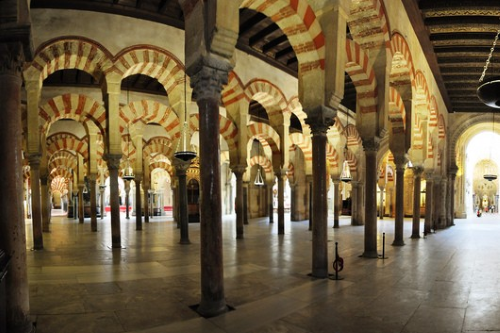
At this point in the route, the experience of the space changes in a very particular way—almost imperceptible at first, but very clear when you pause for a moment and allow your gaze to adjust. The repetition of the aisles, combined with a lower presence of decorative elements, creates a sensation that is difficult to define precisely, yet very evident when experienced: that of a space that seems to have no limits, that extends beyond what the eye can reach, that does not clearly close or establish a recognizable end.
Here, the architecture stops directing the gaze toward a specific point. It does not organize the space around a dominant axis, nor does it establish visible hierarchies or main references. Instead, it unfolds continuously, creating a structure that seems to extend in all directions. The columns follow one another without interruption, the arches repeat in a steady rhythm, the alignments remain consistent, and the result is a perception of spaciousness that goes beyond the building’s actual dimensions.
This effect is reinforced by the lower density of decoration. Unlike other areas where ornamentation concentrates attention on specific points, here the relative absence of prominent elements allows the eye to move freely, without stopping, traveling through the space continuously. This “relative emptiness,” far from implying a lack of richness, is in fact a very precise strategy that allows the architecture to be perceived as a whole—without distractions, without visual interruptions.
It is worth pausing for a moment, slowly turning around, and observing how the space behaves in every direction—how it maintains its coherence, how repetition creates a kind of continuous fabric, as if everything were part of a single structure without beginning or end. This effect is one of the most characteristic features of the Mosque-Cathedral of Córdoba, and it is precisely here that it reaches one of its most intense expressions.
From a perceptual point of view, this sense of infinity is closely related to the scale of the space. The columns are not excessively tall, the distance between them is quite regular, and this combination creates a close relationship with the architecture. It is not a space that impresses through verticality or overwhelms through sheer size, but one that envelops, accompanies, and unfolds around you continuously.
This way of constructing space is very different from the Christian architecture you will encounter later, where verticality, direction, and hierarchy play a fundamental role. Here, by contrast, the experience is horizontal, open, continuous, without a clearly dominant point. It is an architecture that does not impose a path, but instead allows multiple ways of moving and looking.
Beyond its physical dimension, this perception also has a symbolic reading. A space that does not close, that does not set limits, that seems inexhaustible, can be understood as a way of transcending the immediate—of creating an experience that goes beyond the tangible. Repetition is no longer just a constructive solution; it becomes a language, a way of expressing continuity, permanence, and even a certain idea of infinity.
As you move through this area, you may notice how time seems to dissolve, how the route loses a certain linearity, how there is no longer an immediate objective. There is no specific point to move toward, no visible end, but rather a sensation of being within a system that repeats, extends, and remains constant.
This character makes the experience more contemplative. The space does not force you to move forward, does not push or direct you, but invites you to observe, to walk through it calmly, to let your perception adapt to its rhythm. It is a moment in the visit where the architecture is experienced in a freer, more open, more personal way.
This part of the route is key because it represents the extreme point of that expansive logic that has been developing from the beginning. Here, repetition reaches its maximum intensity, continuity becomes almost absolute, and the space shows how far this constructive system can go without needing to transform.
After the richness, intensity, and concentration you have seen in the caliphal area, this space introduces a different sensation—more relaxed in formal terms, more uniform, yet at the same time more enveloping. It is an architecture that reduces visual complexity in order to reinforce spatial experience.
This apparent simplicity does not imply a loss of interest; on the contrary, it allows the logic of the whole to be perceived more clearly, to understand how it works, how it is organized, how it is built through repetition.
From this point on, the route will begin to change again—not so much through an immediate transformation in the architecture you see, but through a shift in the meaning of the building, a historical turning point that will shape everything you discover next, introducing a new phase in the life of this space.
Comentarios
Aún no hay comentarios.