10. Transition to the area of Alhakem II
As you make your way through the interior of the Mosque-Cathedral, your perception of the space begins to shift subtly—almost imperceptibly at first, but with increasing clarity as you continue your tour. So far, you have passed through the building’s initial sections—the original core and one of its earliest expansions—spaces dominated by repetition, the steady rhythm of columns and arches, a sense of continuity, and a certain visual restraint. However, as you approach the section commissioned by Al-Hakam II, you enter a part of the monument where the architecture begins to gain density, refinement, and a much more elaborate character, as if the building, without breaking with what came before, were gradually elevating its architectural language.
This transition is significant because it does not occur through an abrupt break or a radical change in the overall structure, but rather through a gradual transformation of the atmosphere. The visitor does not suddenly leave one space to enter another completely different one, but rather begins to notice, step by step, that certain elements become more complex, more refined, and more deliberate. The architectural logic remains recognizable—the naves, columns, arches, and dominant horizontality continue—but something intensifies; something becomes richer, more concentrated, more ceremonial.
This area corresponds to the great Caliphate expansion driven by Al-Hakam II in the 10th century, at a time when Córdoba was experiencing a period of extraordinary political, economic, and cultural splendor. The Caliphate had established itself as one of the great centers of power in the Islamic West, and that position was expressed not only in administration, diplomacy, or intellectual life, but also in architecture. The mosque, as the city’s great religious and symbolic building, had to reflect that authority, that sophistication, and that level of refinement. For this reason, in this area, the expansion is not limited to increasing the building’s capacity but introduces greater formal richness, a clear desire for monumentality, and a much more pronounced attention to detail.
As you walk, you can sense that the space begins to acquire a greater internal tension. The repetition, which until now created above all an effect of continuity, begins here to shift toward a more concentrated experience. The gaze is no longer lost solely in the infinite multiplication of arches, but begins to detect areas where the architecture stands out more strongly, where certain elements take center stage. It is not yet the culmination of the journey, but it is the section where the building begins to prepare the visitor for it. This preparation is not achieved through signs or explicit cues, but through the architecture itself, which modulates the journey and transforms perception.
It is worth pausing to consider this idea, because one of the great virtues of the Mosque-Cathedral is precisely its ability to guide the spatial experience without imposing it. The building does not force; it suggests. It does not cut off; it modulates. It does not interrupt; it intensifies. And in this transition toward the Alhakén II section, this is particularly evident. The architecture remains continuous, but that continuity is no longer uniform. It begins to be imbued with meaning.
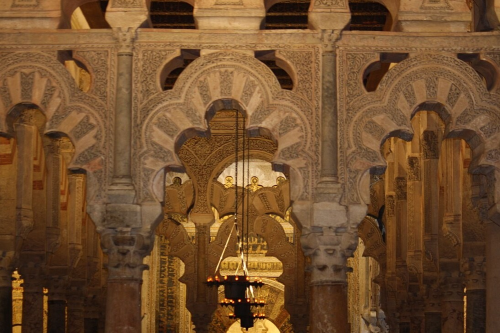
If you observe calmly, you will notice that some arches become more complex, that certain decorative elements appear with greater richness, that the space seems to acquire a distinct solemnity. This is not merely added decoration, but a transformation of the architectural language. The Alhakén II extension marks a moment of maturity, refinement, and sophistication of the previous model. It is as if the building, having established itself in its earlier phases, has reached a kind of formal fulfillment here.
The way the relationship between structure and ornamentation is perceived also changes. In the earlier sections, the visual weight rested primarily on the structural rhythm, on the repetition of the supports, on the almost abstract effect generated by columns and arches. Here, without losing that foundation, the ornamentation begins to gain density and to integrate itself more decisively into the experience. The space is no longer limited to supporting; now it also seeks to represent, to impress, to concentrate symbolic value.
This phase of the building is deeply linked to the most brilliant moment of the Cordoban Caliphate, a period in which the city became one of the great cultural hubs of the Mediterranean world. That ambition, that level of development, translates into a much more refined architecture, where technique and beauty go hand in hand. There is nothing coincidental about this. The mosque was not merely a place for collective prayer; it was also an image of power, a visible manifestation of the Caliphate’s prestige, a space where religion, politics, and representation were inextricably intertwined.
As you move through it, that symbolic dimension becomes more intense. You don’t need to know all the historical facts to sense it. It is enough to look, to pause, to let the space speak. Repetition is still present, yes, but it no longer has exactly the same effect as before. Now it seems to guide, prepare, and focus. The details, once scattered within a uniform structure, begin to take on greater significance. The atmosphere becomes more solemn, more refined, more charged with intention.
It is important to walk through this area without rushing, allowing the eye to adapt to this greater complexity. Perhaps at first the difference from the previous phases does not seem enormous, but the more you observe, the more evident it becomes. The architecture shifts in tone. What in the preceding areas could be perceived as expansion, here begins to feel like an approach to a core of special importance.
This transition also has an emotional dimension. The visitor, even without intending to, begins to notice that they are approaching a unique area. The atmosphere shifts, attention becomes focused, and the experience ceases to be merely exploratory, becoming more expectant. There is a sense of approaching, of entering a part of the building where everything becomes more intense, more valuable, more carefully composed.
And that is precisely the function of this section of the tour. It is not merely a matter of moving from one historical phase to another, nor simply of highlighting a specific expansion, but of experiencing how the building modulates perception and leads toward a space of utmost significance. Here, the architecture acts almost like a ceremonial language, gradually raising the tone of the tour.
Continue moving forward calmly, keeping your eyes open to the changes, the greater richness of the forms, and the growing density of the space, because very soon you will enter one of the most surprising and refined areas of the entire monument, where the roof ceases to be merely a structure and becomes one of the main protagonists of the visual experience.
Comentarios
Aún no hay comentarios.