13. The mihrab
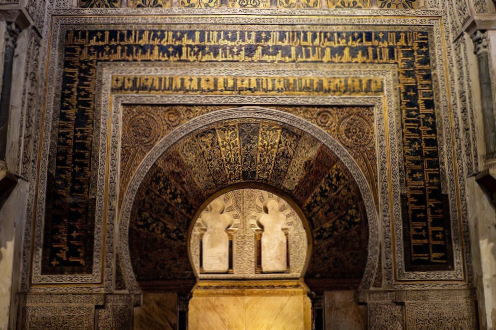
You are now standing before the mihrab, the highlight of the tour of the old mosque—the symbolic and spiritual center toward which the building’s purpose converged, and the place where the architecture reaches one of its most intense and refined expressions. Everything you have seen on your way here—the naves, the repetition of columns, the progressive intensification of the caliphal zone, the domes, and the maqsura—seems to find its greatest concentration of meaning at this point.
In any mosque, the mihrab has an essential function: to indicate the qibla, that is, the direction of prayer toward Mecca. It is not an altar in the Christian sense, nor a place of sacrifice, nor a central scene as in other religious traditions, but rather a sacred indicator, a point of orientation that symbolically organizes the space. However, the mihrab of the Mosque of Córdoba is much more than a simple indicator. Due to its form, its richness, its depth, and its extraordinary craftsmanship, it has become one of the great masterpieces of Islamic art.
Unlike other mihrabs, which are typically designed as an open niche in the wall, the one you see here possesses exceptional depth and complexity. It does not appear merely as an ornamental cavity, but almost as a small room, a space in its own right. This uniqueness gives it a powerful presence and makes it a true focal point. In a building dominated by horizontality, repetition, and continuity, the mihrab acts as a radical concentration of meaning. Here the gaze ceases to wander and finds a clear point of arrival.
The architecture has been building up to this moment. The visitor perceives it almost without consciously thinking about it. After traversing spacious, rhythmic areas, the approach to the mihrab involves a progressive intensification of the experience. Everything becomes more precise, more laden with intention, more ceremonial. The space is organized to highlight this spot, to emphasize that here lies the spiritual center of the mosque.
If you observe it calmly, you will see that its shape, proportions, and architectural setting are carefully composed to make it stand out. The mihrab does not impose itself through size, but through quality, symbolic density, and refinement. Its power lies not in being enormous, but in being extraordinarily significant. It is one of those places where architecture needs no excess to achieve grandeur.
This point concentrates not only the building’s religious function but also much of its artistic ambition. The proximity of the maqsura, the richness of the nearby domes, and the uniqueness of the mihrab itself make this area the most noble core of the entire expansion by Al-Hakam II. Here the Caliphate sought to showcase the best of itself, not only in terms of faith, but also of culture, technique, and aesthetic sensibility.
There is also something very important about the experience of this place, and that is the relationship between intimacy and monumentality. The mihrab does not overwhelm with colossal dimensions, but it does impress with the intensity with which it is conceived. It produces a sense of concentration, of contemplation, of very powerful solemnity. Everything seems to be designed to create a special atmosphere, distinct from the rest of the mosque. The architecture no longer expands; here, it condenses.
In symbolic terms, the mihrab represents an invisible axis. It is not the geometric center of the building, but it is the spiritual center of its orientation. The entire community praying in this space directed its attention toward this point. This function makes the mihrab, in a sense, the focal point toward which the entire religious experience of the mosque is oriented. Its value, therefore, depends not only on its beauty but on its role as a fundamental reference point for the ritual and the meaning of the building.
At the same time, the exceptional artistic quality of the mihrab in Córdoba reveals the extent to which the Caliphate sought to endow this space with a unique character. We are not dealing with a functional solution enriched by decoration, but rather with a work conceived to be memorable, to express prestige, refinement, and a lofty vision of religious art. It is architecture that orients, but also marvels. That guides, but also represents.
It is worth pausing to contemplate it without haste. Not as a famous image that is simply recognized, but as a space that is revealed little by little. Observe how it integrates into the wall, how its presence alters the atmosphere, how the space around it seems to tighten and focus. Here, architecture ceases to be merely a sequence and becomes fully the center.
It is also worth reflecting on the immense historical continuity that this place embodies. For centuries, this was the point toward which prayers were directed in the Great Mosque of Córdoba, the place imbued with sacredness within the Islamic building. Later, with the monument’s transformation into a cathedral, this space ceased to fulfill its original function, but it did not lose its power. It remains one of the most impressive and significant points of the complex, capable of retaining its aesthetic and symbolic power even after the building’s change of use.
The visitor’s experience here is often very intense. After the prolonged rhythm of the tour, after the expanse of the forest of columns, the mihrab acts as a kind of visual and emotional culmination. Not because the monument ends here, but because this point uniquely brings together art, function, symbolism, and history. It is, in many ways, the heart of the old mosque.
But if anything further multiplies its impact, it is the extraordinary decoration that covers it—a surface of brilliance, color, and detail that transforms this space into one of the pinnacles of Caliphate art. Take a closer look at it, because at the next stop you’ll be able to observe one of the most fascinating aspects of the entire building: the mosaics that make this place truly one-of-a-kind.
Comentarios
Aún no hay comentarios.