08. Area of Abderramán I
This is where the history of the Mosque-Cathedral of Córdoba, as we know it today, truly begins. You are standing in the oldest part of the building, in the original core constructed in the late 8th century by order of Abd-ar-Rahman I, and this spot holds special significance on the tour, because everything you’ve seen so far—the repetition of columns, the succession of arches, the constant rhythm of the space, the sense of continuity—begins precisely here, in this first phase of construction, though initially on a much smaller, more restrained, and simpler scale.
At that time, the mosque was a much smaller building than the one you are touring today; it was organized into a series of naves oriented toward the south, following the direction of prayer toward Mecca, and was conceived as a functional space, designed to accommodate a community that was beginning to take root in the city; it was not yet monumental architecture in the sense it would later attain, but rather a place of gathering, prayer, and religious life, adapted to the specific needs of its time.
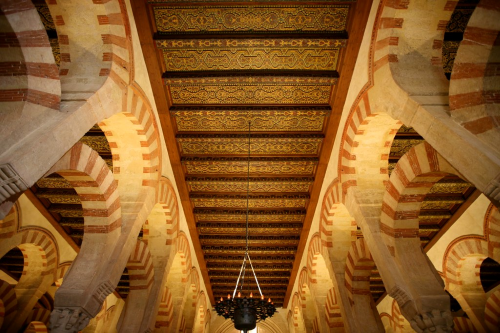
And yet, despite that more modest initial scale, many of the elements that would come to define the building’s identity over the centuries were already present in this first phase: the reuse of columns from earlier structures, the system of superimposed arches, the horizontal organization of space, the orderly repetition of elements— all of that is already present here; it is as if the foundations, the essential rules of an architecture that would later grow, expand, and become more complex, were established in this area—yet without entirely losing its original logic.
If you pause for a moment and observe calmly, you may perceive a sensation somewhat different from that of other areas of the tour; the space here may seem more intimate, more contained, as if it still retained something of the initial character with which it was conceived. It is not a sudden difference, nor a clear break that imposes itself on the eye, but rather a subtle impression, a more intimate, closer atmosphere, corresponding to that first moment of construction.
This perception is particularly interesting because it allows us to interpret the building not only as a continuous whole but as a sum of stages; here you are not simply inside a mosque that has been expanded many times over, but at the point where it all begins, at the place from which a way of constructing space originates that will later extend and multiply; this area functions almost like a seed, small in comparison to the subsequent development, yet decisive for understanding everything else.
The construction of this first mosque also responds to a need that goes far beyond the purely functional; for Abd-ar-Rahman I, erecting this building had strong political and symbolic value. Following the fall of the Umayyad dynasty in the East, he established a new center of power in Córdoba, and the mosque became one of the fundamental instruments for asserting that presence; it was not merely a place of prayer, but also a symbol of legitimacy, continuity, and consolidation in a new territory.
For this reason, this first phase of the building must also be understood within a broader context: the mosque was not created solely to meet an immediate religious need, but also to express the birth of a new political reality in Al-Andalus. Architecture, in this sense, not only organizes space but also communicates, represents, and affirms; even in this initial, more restrained stage, the building already participates in that symbolic dimension.
The location chosen for its construction is no accident either; this site already had a long-standing tradition, reinforcing the idea of historical continuity that runs through the entire monument. Over the centuries, various uses and structures have occupied this very space, and the mosque fits into that sequence, initiating a new phase that would profoundly transform the city’s history. This layering of times, uses, and meanings—which will later become so evident in other parts of the tour—has one of its earliest foundations here.
As you walk through this area among the columns, it is worth trying to imagine what this space must have been like in its original form—smaller, simpler, yet already possessing a very clear architectural intent. The repetition of elements, the organization into naves, and the general orientation of the complex are all already defined, even though it has not yet reached the monumental scale you will see later on. There is a clarity of design here that is highly revealing.
It is also important to note how the later expansions largely respect this initial structure; rather than breaking with it, they extend it, adapt it, and expand it, allowing this original core to remain recognizable within a much larger building. That continuity does not mean immobility; on the contrary, it signifies the capacity for growth without loss of identity. The mosque will change, yes, but it will do so from a foundation that is clearly established here.
The sense of continuity you have been experiencing since entering the interior therefore has its starting point here; from this initial core, the building begins to expand, responding to new needs, to a growing population, and to Córdoba’s increased political and religious significance. Each expansion will add new layers, new nuances, and new solutions, yet maintain a coherence that originates precisely here.
If you continue to observe carefully, you will notice that this area does not impress through excess or particularly striking ornamentation, but rather through its foundational value. Here, spectacle matters less and origin matters more; it is the place where a way of constructing space is defined, where relationships, proportions, and a system are established that will later be repeated and become more complex. In that sense, this point is of enormous importance, even if it is not always the most obvious from a visual standpoint.
As you continue walking a few more meters, you will begin to perceive how the space starts to open up, to expand, to multiply. This expansion does not occur abruptly, but gradually, accompanying the building’s growth over time, and precisely there lies one of the keys to understanding the mosque’s evolution: in its ability to grow without losing continuity, to expand while remaining recognizable.
This place is, therefore, not just another part of the tour; it is the origin of everything you have seen and everything that will come after. It is the point where the foundations are laid, where a way of organizing space is defined that will be repeated and expanded over the centuries, until this building becomes one of the great landmarks of Western Islamic architecture.
Continue exploring this area at a leisurely pace, paying attention to the details, the subtle differences, and the sense of scale and origin that can still be felt here, and keep moving in the same direction, because in the next section you will see how this initial structure begins to expand, giving way to one of the building’s first major transformations.
Comentarios
Aún no hay comentarios.