12. The maqsura, reserved area
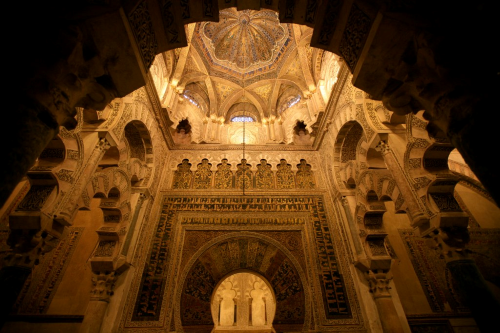
Before you lies one of the most unique and significant areas of the mosque, a space that stands out not only for its architectural richness but also for what it reveals about the political and religious organization of the Caliphate of Córdoba. Here, architecture ceases to be merely a repetitive and continuous system, becoming instead a more precise, more deliberate language capable of expressing hierarchy, power, protection, and representation within a single space.
This place, known as the maqsura, was reserved for the caliph and his inner circle, making it a space clearly distinct from the rest of the prayer hall. Unlike the areas open to all worshippers, a distinction is established here—not absolute in physical terms, but very evident in its layout, treatment, and meaning. It is not a completely enclosed enclosure, nor is it an open space; it is a protected, delimited area designed to fulfill a very specific function within the complex.
Its existence is directly related to the caliph’s role in the society of the time. In the context of the Caliphate, the ruler exercised not only political authority but also a religious function, which meant that his presence in the mosque carried enormous symbolic weight. Participating in public prayer was a form of legitimization, of visibility, of affirming his role within the community. However, that presence also entailed risks, making it necessary to create a space that would allow his participation without exposing him in the same way as the rest of the faithful.
That balance between visibility and protection is clearly evident in the architecture itself. This space is not hidden; it is not relegated to a secondary location. On the contrary, it occupies a prominent position within the complex, very close to the mihrab, the mosque’s most spiritually significant point. This proximity directly expresses the caliph’s rank, his relationship with the religious center, and his role within the political and spiritual order.
At the same time, the way this area is delineated marks a clear distinction from the rest of the space. The architecture becomes denser, more elaborate, more concentrated. The uniform repetition of columns and arches, which defines the forest of the prayer hall, gives way here to greater individuality. The elements become more complex, richer, and more deliberate, creating a distinct atmosphere—more intimate, more ceremonial.
If you look at the arches in this area, you will notice how their form becomes more sophisticated, how the lines multiply, and how the structure gains greater complexity. It is no longer just about supporting, but also about framing, protecting, and highlighting. The architecture here is not merely functional; it is also representative, expressing a special status within the complex.
This change does not break with what came before, but rather nuances and intensifies it. The language remains the same, but it is modulated, adapted, and transformed to fulfill a specific function. This ability to differentiate without disconnecting is one of the great qualities of Islamic architecture, and it is clearly evident here.
The space ceases to be completely open, ceases to be undifferentiated, and becomes a realm with its own identity, directly linked to the exercise of power. Without the need for closed walls, without resorting to total separation, the architecture manages to create a distinct, recognizable space, laden with meaning.
This place highlights just how much the main mosque was far more than a space for prayer. It was also a stage for political representation, a place where the order of the state became visible, where hierarchy was expressed in a concrete way. The caliph’s presence at this point reinforced his status as leader and protector of the community, establishing a direct link between political power and religious authority.
The proximity to the mihrab is not merely a matter of location; it is also a symbolic statement. Standing next to the point toward which prayer is directed implies closeness to the spiritual core of the building—a privileged position that reinforces the ruler’s role within the complex.
If you look closely, you will notice how the decoration becomes concentrated, how the details multiply, how the space acquires a density you had not perceived until now. This concentration is not accidental; it responds to the need to emphasize the importance of the place, to distinguish it without isolating it, to integrate it without making it invisible.
As you visually traverse this space, it is easy to perceive that something different is happening here. Even without knowing its original function, the architecture conveys a sense of uniqueness, of importance, of presence. That ability to communicate through form, rhythm, and density is one of the most powerful characteristics of this building.
This setting also reflects the complexity of the society in which it was built—a society where religion and politics were deeply intertwined, where religious space was also a space of power, representation, and legitimacy. The architecture, in this case, not only responds to practical needs but also translates a social structure into spatial terms.
It is worth pausing for a moment, observing calmly, letting one’s gaze wander over the arches, the details, the relationships between the elements, perceiving how the space closes in slightly, how it becomes more contained, more expressive. This moment of pause allows for a better understanding of the change taking place here, not as a rupture, but as an intensification.
From this point, the proximity to the mihrab becomes evident, not only physically but also in terms of perception. Everything seems to be oriented toward that place, toward that symbolic core that concentrates the deepest meaning of the building.
Before continuing, take a moment to absorb this change, to recognize the uniqueness of this space within the complex, to perceive how the architecture adapts, transforms, and becomes specialized without losing its overall coherence. The sense of having arrived at a particularly significant space is clear, and it will be reinforced at the next point, the spiritual heart of the mosque, toward which the entire prayer was directed and around which the deepest meaning of this place was organized.
Comentarios
Aún no hay comentarios.